

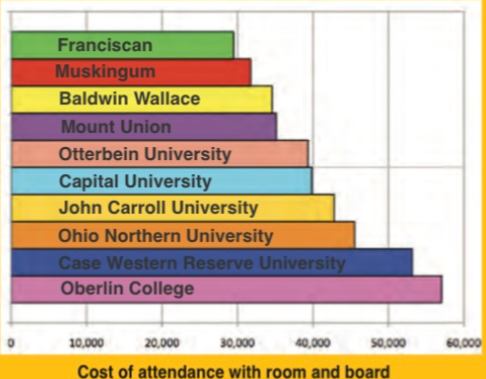
Over the last several decades, John Carroll University has evolved in many ways, such as implementing new programs, renovating and building new facilities around campus as well as creating jobs for students and staff. Tuition costs steadily increase in order for these exciting enhancements to be seen around the university. Every time it goes up, the growth percentage is never the same. The Carroll News pulled archives to look into a brief evolution of the costs for attending JCU.
In a January 1975 issue, news editor Pat Behmer informed JCU students about a $3 per credit hour tuition increase taking effect in September 1975. This would raise the tuition rates for undergraduate students to $63 per credit hour, while graduate students’ fees increased to $68 for each credit hour. Depending on how many classes were taken, the total tuition was between $2,000 and $2,200.
Room and board rates were raised the following fall from $1,075 to $1,100. Financial aid even saw an increase, which included federal and state funds.
“Our choice was either to sacrifice quality in programs or raise the tuition,” said Fr. Henry Birkenhauer, then-president of JCU.
Similarly, news editor Tom Miller stated in a March 1985 publication that the tuition and room and board costs were going to rise for the 1985-1986 academic year. The JCU Board of Trustees approved an increase to $167 per credit hour and $3,100 for room and board. The previous costs are unknown. The reason for this tuition jump was salary increases for a lot of faculty and staff.
“To attract and retain excellent faculty staff members requires a salary schedule which is competitive with other colleges and universities,” said Fr. T.P. O’Malley, university president at the time. “We want to be able to choose faculty members from among the best available.”
In addition to raises among JCU faculty and staff, other factors contributed to the tuition rise, including the hire of a new dean of student development and the construction of the Recplex. Utilities, food costs and dorm maintenance saw an increase in costs.
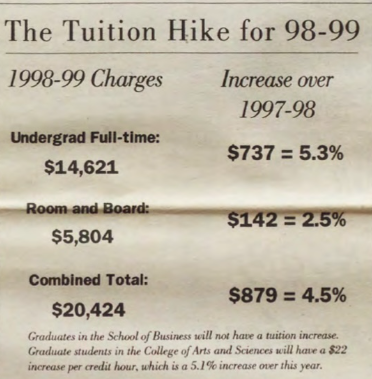
In a February 1998 edition, there was a story written by Jill Jasinski about the cost of tuition increasing for the 1998-1999 academic year. In December 1997, the Board of Trustees voted to increase undergraduate tuition by 5.3%, while room and board costs went up by 2.5%. Graduate students in the College of Arts and Sciences saw a 5.1% tuition increase, bringing it up to $450 per credit hour. The costs of postgraduate degrees in the Boler College of Business weren’t affected.
Jonathan Ivec, member of the finance and audit committee, listed many reasons for the tuition increase, the main one being raises for JCU professors and staff. The growing cost of medical coverage for employees was another factor. Also, the rise in utility costs, increase in student scholarships and grants, as well as the renovation of Bernet Hall, contributed to the attendance costs.
A January 2009 newspaper reported the lowest one-year tuition rate increase in JCU’s history as a result of the 2008 stock market crash.
For the 2009-2010 academic year, the tuition was raised by only 2.8%. The cost to attend JCU was $27,940, which was a $750 increase from the previous year. Room and board cost $8,330, which was a $396 increase from the previous year.
Fees such as student activity, technology and health services did not change for the next school year. Richard Mausser, who was the vice president of finance, said that the university decided on the lowest tuition rate increase due to “an affordability concern.” There was consideration for absolutely no cost increases for the 2009-2010 academic year, but that was fiscally not possible.
“I believe our increase this year, the smallest change in our school history, is reflective of our commitment and priority to keep JCU affordable for our students,” said Brian Williams, who was the vice president for enrollment.
The increase in room and board rates was mentioned months earlier than usual to allow families ample time to prepare for paying the expenses during the upcoming school year. The Office of Financial Aid strived to come up with ways to make paying college expenses less stressful for JCU students and their families.
In a story from a February 2013 publication, Ryllie Danylko and Dan Cooney wrote that JCU raised the tuition costs for the 2013-2014 school year from $32,130 to $33,330, which is a 3.9% increase. The room and board prices changed depending on the dormitory students were living in, as well as the amenities and meal plan that were chosen. The average price for full-time undergraduate students, including room and board, was $34,480.
The technology fees for 2013-2014 changed from $400 to $450, while the health and wellness fees revised their costs to $300 from $250. The student activity fee remained at $400. Students taking classes over the summer of 2013 paid $700 per credit hour, which was the same amount as the previous summer.
For the 2025-2026 academic year, the tuition cost for undergraduate students is $50,160, with room and board costing $14,950. The cost per credit hour for graduate students depends on the program they are enrolled in.
Understanding the evolution of attendance costs at JCU helps students better recognize the many factors that shape a quality education. As a private university, John Carroll continues to see tuition increases, students can evaluate how their investment in college education supports the future of this university.

Jesse Capps • Mar 26, 2026 at 10:25 am
Miss Marlow,
Class of 2000 alum here.
Thanks for the contemporary historical overview of tuition increases. I do wonder if (if) JCU is simply pricing itself out of a certain market regading potential students. Time will tell.