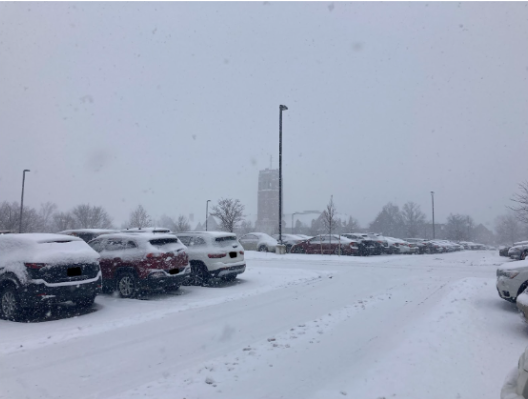
Over the last few weeks, many days were filled with cold temperatures, blizzards and ice storms that forced many schools, colleges and universities to consider closing or abbreviating their hours. John Carroll University has been in this boat several times, as many emails were sent to the campus community regarding the university’s decisions to remain fully or somewhat operational amid questionable weather.
University operations are decided using the weather emergency plan, which is available to all JCU community members under the featured links section of their MyJCU account. The decision team includes Bonnie Gunzenhauser, Ph.D (vice president of academic affairs), Naomi Sigg (vice president of student experience and campus belonging), Lisa Brown Cornelius, Ph.D (assistant vice president of student experience and campus belonging and dean of students), Jeffrey Daberko (JCUPD chief) and Sarah Forrer (assistant vice president of marketing and communications).
“These were the metrics the group applied on Jan. 15 in assessing the impact of the snowfall on campus operations, on Jan. 20 in assessing the impact of the cold temperatures on campus operations and again [Jan. 24, 25, 26 and 27] in assessing the impact of the snow and cold on campus operations,” said Gunzenhauser. “The plan also recognizes that individuals may need to make decisions for themselves based on their individual circumstances, and that the University will accommodate those individual decisions as much as possible.”
At 5:01 p.m. on Jan. 14, students, faculty and staff were notified via email that the university was going to remain open on Jan. 15 amid blizzardy conditions with the goal of being “open and operating whenever possible.”
Just after 7:00 p.m. on Jan. 19, the JCU community received an email stating that the university was expecting “to be fully operational” on Jan. 20, which was predicted to have 15 below-zero windchills. It also contained advice to dress in layers, limit outdoor time, watch for symptoms of frostbite and hypothermia and be cautious on sidewalks that are snowy and icy.
“I was walking to class in what felt like [15 below zero on Jan. 20],” said a commuter student who wanted to stay anonymous. “One of my [professors] said I would miss attendance points, so I figured I would just go. I just bundled up and went. On [Jan. 15], I didn’t go at all [because] my street wasn’t plowed.”
“I didn’t have any classes on [Jan. 15] because the morning classes were cancelled and my [chemistry] teacher cancelled his afternoon class,” said Kyle Carroll ’29. “I did go to my classes on [Jan. 20] because I just needed to walk across campus.”
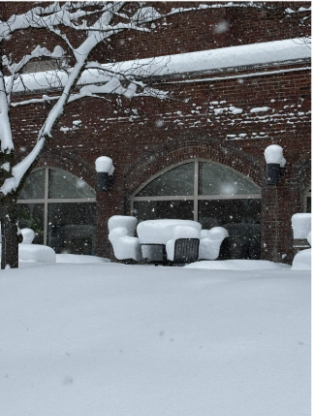
“I [attended] my classes on those days,” said Annie Costello ’27. “I decided to go mainly because classes were still being held and I didn’t want to fall behind academically. Overall, I believe the university did try to maintain operations as best as they could given the conditions.”
According to the university’s emergency short-term closure policy that was included with the emails from Jan. 14 and Jan. 19, JCU might close or reduce operations “because of inclement weather, natural or public disasters, energy system failures or other similar emergencies.” In the event of an emergency that poses a risk to the health or safety of community members, the university will close and classes will be cancelled.
Additionally, these decisions are made when “the campus is or is expected to be unprepared for parking and pedestrian traffic, local road conditions are projected to be hazardous and preclude continuation of public transportation and/or there are utility and power outages that impact the working environment.”
“I personally felt that remaining fully open on [Jan. 15] was not the best decision, and [Jan. 20] felt a bit iffy as well,” said Costello. “While I understand the difficulty of making decisions that affect the entire campus, those days felt challenging from a safety standpoint.”
“I think they should have cancelled on [Jan. 20],” Carroll added. “All the high schools and universities in the area cancelled because of the extreme cold, except us. Even though I had a warm coat, it was really bitterly cold walking across campus from Dolan Hall to Dolan Science Center in the morning with the wind blowing. I think it definitely could have been a safety issue for students and staff.”
During the afternoon of Jan. 24, it was announced that operations for that evening would be reduced and JCU would be closed the following day due to heavy snowfall that was projected to start on Jan. 25 across several states.
“The fact that they shut campus down [on Jan. 25] makes zero sense [because] no one has class,” said the commuter student. “I really don’t get it.”
“I feel like they made the right choice to close Sunday despite not having classes,” said Costello. “It’s better to keep people safe.”
“I think the university canceling over the weekend with the storm was the right call since the staff members [did] not have to drive to work through the storm,” said Carroll. “It was a good idea to keep everyone safe since we still had the weather warnings.”
In-person classes were cancelled and services were abbreviated on Jan. 26 and Jan. 27 due to the continued snow and extreme cold temperatures.
“I’m just happy they took all of us commuters into consideration,” the commuter student added.
Gunzenhauser told The Carroll News that making these decisions are always difficult since inclement weather poses a range of challenges. “Our goal is to strike the best possible balance between maintaining opportunities for our students and ensuring the health and safety of all members of our community.”
Another method of communication the university uses in the event of emergencies is JCUAlerts, which texts and emails the campus community with important information they need to know. Due to the character limit on text messages, users are referred to follow up emails. Students, faculty and staff are enrolled in these alerts at the beginning of their JCU careers unless they choose to opt out.