

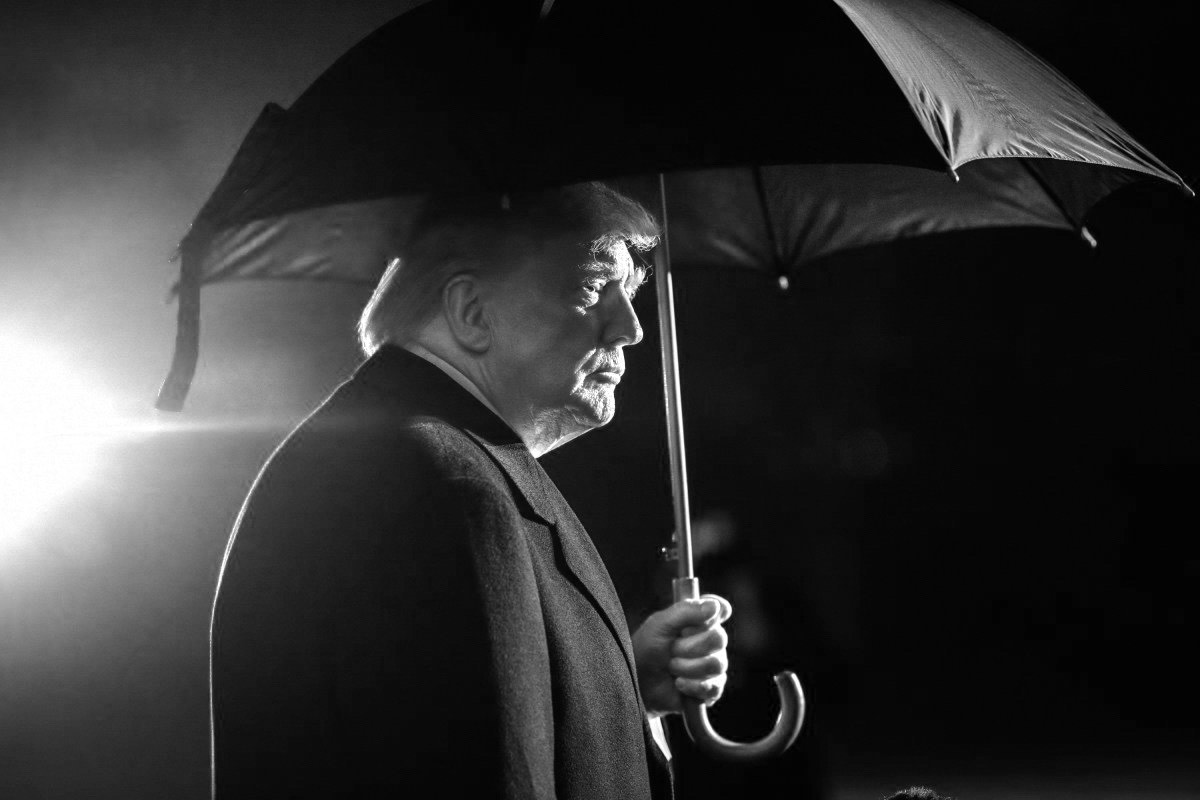
When Customs and Border Control Agents shot and killed Alex Pretti in Minneapolis on Jan. 24, 2026, the event prompted nationwide walkouts and protests, including one among John Carroll’s student body. This was the cap on a remarkable year of presidential politics, marked by President Trump’s inauguration promise of a “tide of change” across the country.
Since his inauguration, Trump has instilled that tide of change, taking swift and sometimes chaotic action on his key campaign promises, including immigration enforcement, tariff policy and numerous cultural issues. On the foreign front, Trump has made consequential decisions that have both ostracized and encouraged American allies. All the while, Trump has shifted the traditional independence of executive agencies, including the Department of Justice.
Joe Bilas ’27, president of the Democrats of JCU, called it “an executive primarily concerned with playing politics.” Bilas said, “America isn’t safer, the world is not more stable or secure and the issues people are truly worried about haven’t been tackled.”
Immediately after Trump’s inauguration, the U.S Department of Homeland Security began deploying ICE (Immigrations Customs and Enforcement) agents across the country to fulfill Trump’s promise of the largest mass deportation effort in American history. A year into this campaign, illegal border crossings have plummeted, while a record number of migrants are being detained across the country. To accommodate these migrants, state and federal officials have built new detention centers, including Alligator Alcatraz in Florida, which has faced accusations of inhumane treatment. Elsewhere, the Trump administration has outsourced migrant detention to CECOT, an El Salvadorian prison with a history of torture.
Despite claims that the administration is targeting the “worst of the worst,” data shows that less than 14% of ICE arrests have been people with violent criminal charges or convictions. Additionally, ICE has detained at least 170 U.S citizens, according to ProPublica. Margaret Wong, an immigration attorney practicing across five states, said, “It’s just a mess, they don’t even know what they’re doing. So if they catch people and put people in jail, it can be two or three days before they even find these people.”
ICE has added 7,500 new agents in the last year and shortened training time. Agents have often worn masks, operated in plain clothes and in some cases refused to identify themselves or their agency. Moreover, increasingly aggressive tactics by ICE and CBC agents have resulted in sometimes violent protests across the country.
Isaiah Gray ’27, president of the College Republicans of JCU, said, “as far as immigration enforcement goes, Trump is far too tame. The insurrection act should have been used in Minnesota. As soon as you bring in the military and start arresting obstructors, the remaining obstructors will quickly disperse.”
Wong said immigration enforcement tactics are creating a culture of fear among her clients. Wong said, “It’s horrible. Families are struggling with each other, wives are getting deported, husbands… it’s not fair for young people, there’s a lot of mental health issues, a lot of family separation issues … so yes, times have changed, people are scared and they get very angry.” This unrest reached a head in Minneapolis, where a large ICE operation resulted in the fatal shooting of two American citizens as well as numerous protests.
In his first year, Trump has also taken action on another core tenet of his campaign: economic improvement, especially through tariffs. On April 2, 2025, Trump announced wide-ranging tariffs on what he called “Liberation Day.” The results have been mixed: the government has taken in approximately 287 million in revenue, but many American businesses have had to account for the extra cost. Inflation has seen a marginal decrease from 2.9% to 2.7%. After a rough 2025, the first month of 2026 had a slightly more hopeful jobs report, adding 130,000 jobs against an unemployment rate of 4.3%.
On the campaign trail, Trump positioned himself as the candidate for peace, promising to end the war in Gaza, along with the Russia-Ukraine War. One year in, Trump has helped to broker an unsteady cease-fire between Israel and Gaza, while the Russia-Ukraine War is ongoing, despite Trump’s promise he would be able to end it on “day one.”
Meanwhile, the Department of Defense has carried out several significant military actions, including bombing three Iranian nuclear sites in June. The DOD has also targeted boats in Venezuela which it claims are carrying drugs and captured Venezuelan President Nicolas Maduro on charges of narco-terroism.
A key portion of Trump’s campaign rested on culture war issues and, as President, he has delivered for those who agree with him. On day one, Trump signed an Executive Order making the existence of two genders official government policy. Trump has removed DEI programs from the federal government and has pulled funding from universities which have not met the administration’s demands. Other changes include informally renaming the DOD to the Department of War, prioritizing classical architecture in federal buildings and removing “non-agency” flags, including pride flags, from federal buildings.
Throughout this rapid policy change, Trump has also shifted the functions of the Executive Branch closer to that of a unitary executive, allowing him to wield more influence over the federal bureaucracy than in his first term.
At the DOJ, Trump has moved away from the post-Watergate tradition of independence from the president. Instead, The Department has pursued, and in some cases charged, several of Trump’s political enemies. The DOJ has offered conflicting explanations on files pertaining to alleged sex-trafficker Jeffrey Epstein, with whom Trump had a relationship at one point, and has missed the legal deadline for releasing the full-breadth of those files.
Throughout his first year, Trump has delivered on key campaign promises including immigration, tariff placement and culture war issues, but not without a cost. Protests have emerged nationwide in response to ICE tactics, while his tariff experiment is yet to yield economic benefits. All the while, Trump has dissolved much of the traditional independence of executive agencies. None of this is new: testing legal boundaries has been a presidential norm for centuries. What is more unique is the speed of the action. This strategy of “flooding the zone” has allowed Trump to do a lot, but as his approval rating sits in the low 40s, it is clear that many Americans are not feeling the benefits.
Tony Slepko • Feb 23, 2026 at 11:47 am
Refreshing to see multiple sides represented, and no inflammatory language.