“We have professionalized what it means to be a Supreme Court Justice and to become a Supreme Court Justice.”
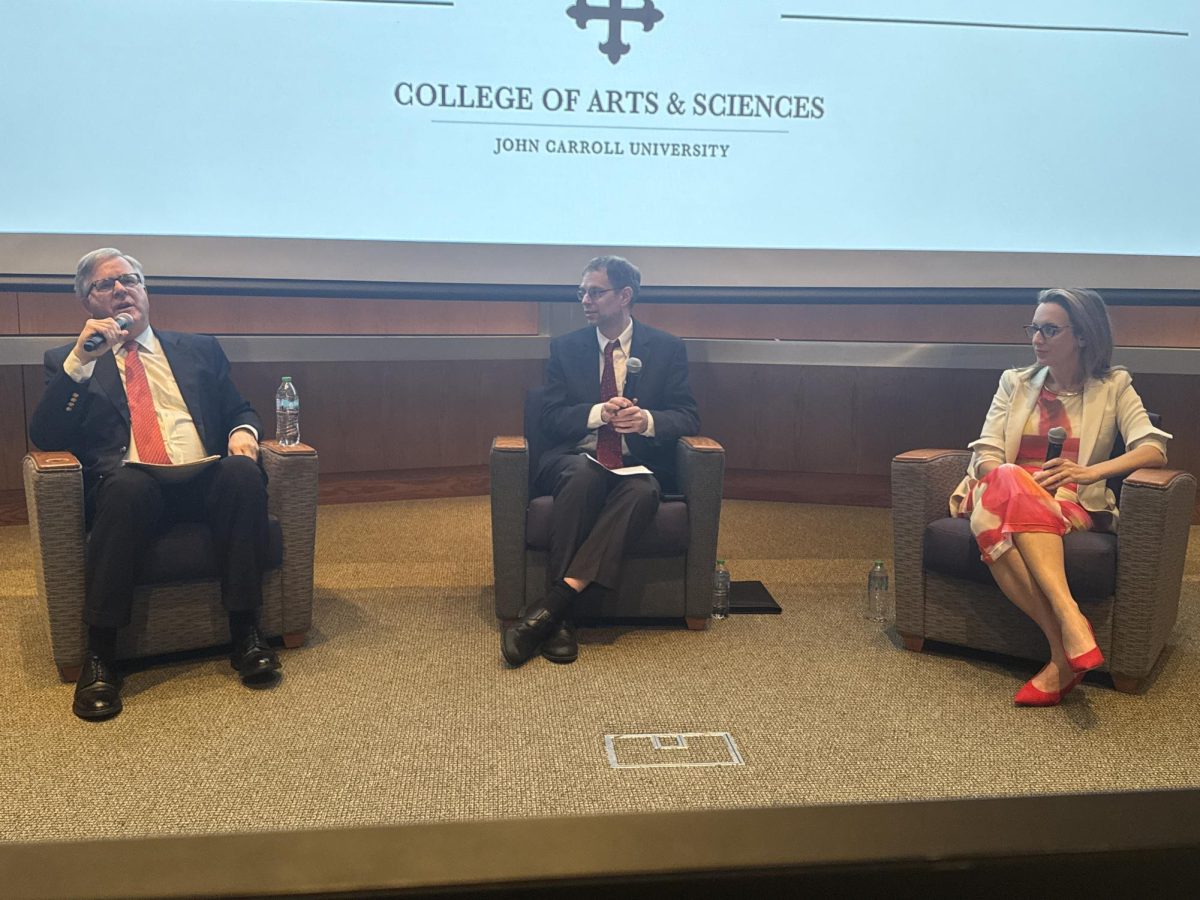
With that sharp critique, Sarah Isgur immediately framed a candid, at times pointed, conversation about the modern judiciary during a discussion on “The 6–3 Split: How the Supreme Court Is Reshaping Federal Power” on March 26 at John Carroll University.
Isgur, known for her work as a former spokesperson for the U.S. Department of Justice and a political analyst and co-host of the legal podcast “Advisory Opinions,” brought both insider experience and media perspective to the discussion. Alongside her was Pete Williams, journalist in residence at JCU and former Supreme Court Justice Correspondent for NBC. The event was moderated by Colin Swearingen, Ph.D., professor of Political Science.
Speaking to a packed audience of students and faculty, Isgur argued that the path to the nation’s highest bench has become increasingly narrow and predictable. Today’s justices, she noted, often share remarkably similar résumés: elite law schools, prestigious clerkships and years spent within the federal appellate system.
“That wasn’t always the case,” she said, emphasizing that the court once drew from a wider range of professional and personal backgrounds. The shift, she suggested, has contributed to a more insulated judicial culture, one that may shape how justices interpret the law and understand its real-world consequences.
Williams, drawing on decades of reporting, offered a steady counterbalance, situating the current moment within a broader historical context. While acknowledging the significance of the 6-3 split, he cautioned against reducing the court to a purely partisan institution.
“Yes, the alignment is more visible now,” Williams said, pointing to a series of high-profile rulings that have followed ideological lines. “But it’s not absolute.” He highlighted instances where justices have broken ranks, underscoring that legal reasoning, not politics alone, still drives many decisions.
Even so, both speakers agreed that public perception of the court has shifted dramatically. Increased media coverage, politically charged confirmation battles and landmark rulings have pushed the court into the national spotlight in ways rarely seen before.
That visibility, Isgur noted, comes with consequences.
“The more we talk about the court in political terms, the more people start to see it that way,” she said, raising concerns about how that perception could erode trust in the institution.
Students in attendance leaned into those tensions during a Q&A session, posing questions about judicial legitimacy, lifetime appointments and the increasingly contentious nomination process. Several asked whether the court can maintain credibility in such a polarized environment.
During the question-and-answer session, Williams emphasized the importance of transparency and informed reporting, arguing that understanding the court requires looking beyond headlines to the legal reasoning behind each decision.
The discussion ultimately circled back to its opening theme: how the evolution of the court, both in composition and perception, has reshaped its role in American life.