Back in high school, I was nothing but an arts kid, taking drama class each semester, acting in every play and musical, singing in concert choir and performing in wind ensemble and marching band. For three years, marching band was the biggest part of my identity. I always looked forward to Friday night football games, parades and marching through the hallways of my school. Additionally, all participants get the opportunity to go to Disney at some point during their time in marching band, so I was especially excited for that opportunity which would come near the end of my junior year.
The Disney trip that I was anxiously awaiting for was unfortunately cancelled on March 13, 2020, the same evening the coronavirus was declared a pandemic in the state of Ohio, less than a week before the band was set to depart. That same day, I found out that my school district was switching to virtual learning for the foreseeable future. Little did I know this would be my last day of in-person high school.
When it came time to prepare for the start of my senior year, I had to choose between in-person or virtual learning for the entire academic year. Since I was thriving with online learning at the time and didn’t feel safe going to school, I opted for attending classes via Zoom.
Many students at John Carroll University most likely experienced the same situation. Whether it was a restructured academic year, cancelled sports season or lost graduation, the coronavirus era introduced a lot of abrupt change. For me, this moment came to life when I found out that those in marching band choosing to learn virtually were not eligible to participate. This was extremely devastating since I wasn’t going to have a senior season of the activity I loved most.
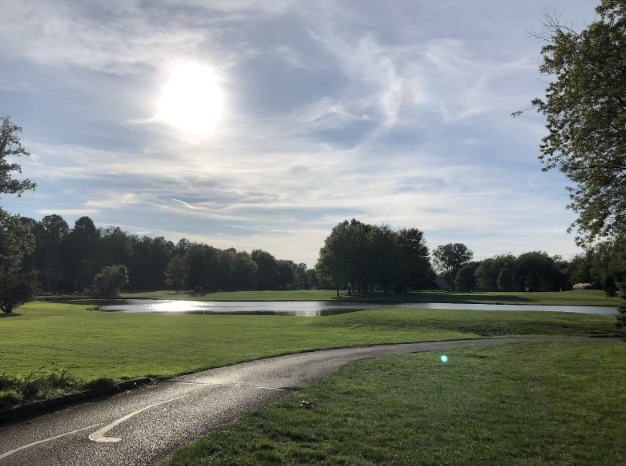
Throughout that summer, the majority of businesses were closed in my hometown due to the pandemic and the only thing there was to do was golfing. As a result, my family became more involved with the sport, frequently visiting driving ranges and playing nine or eighteen hole rounds on the weekends. An opportunity came up for me to join the girls’ varsity golf team (there was no junior varsity team) in the fall of 2020. I chose to take it because I felt my golfing skills were getting better and wanted the experience of playing a high school sport.
I’m among the 10% of the global population that golfs left handed. My coach and teammates found that to be an advantage, so I was often placed higher in match lineups and competing directly against stronger golfers. I stuck out like a sore thumb compared to the other people on my team, so there was a lot of pressure for me to do well.
As the season progressed, I quickly learned that golf is more rigorous and harder than it looks and mentality is crucial to successful performance. Patience is also essential to doing well in the sport. While playing varsity golf and even to this day, remaining positive throughout an entire match is difficult since one bad shot would ruin a hole and one bad hole spoils my entire game.
The most challenging aspect of golf is shooting the least amount of strokes possible. On top of that, players had to walk to their ball instead of drive golf carts. I often had to add an additional shot to my score since I easily lost track of where my ball landed after the previous shot.
My long game was a lot better than my short game and this still holds true today. Once reaching the green, it would usually take three or four putts before getting the ball into the hole, therefore obliterating my score. I shot a par maybe twice and a birdie once since I first began playing, to which many opportunities to increase those counts have been spoiled by my lack of short game talent.
Golfing terminology can be incorporated into a valuable lesson for any JCU student. It is often to first arrive at college with some sort of a “long game” plan, such as the major or minor to complete, the extracurricular activities to join and career to pursue. Then all of a sudden, those plans can abruptly change, once the “short game” hits and realizing that the original idea is not fitting in ways such as flunking a class, losing passion or being introduced to a new opportunity. In golf, the long game helps, but it’s quite frankly the short game that determines a score, similar to college, where those short game moments shape the overall experience.
Most of the matches my team played were only nine holes, where my lowest round was a 48. We did two 18-hole tournaments that season and my best was around a 125. I don’t typically keep score since it applies too much pressure on my gameplay. However, there is always room for improvement in the number of strokes I take per round.
Even though I learned how to play golf, a sport that can be played leisurely for the rest of my life, and gained experience playing at the varsity level, I never felt the same sense of belonging that marching band gave me. As one that has been performing on stage the majority of her life, I’ve always enjoyed having the spotlight and providing entertainment, which is something golf didn’t offer. The golfing environment is too silent and doesn’t provide the same level of energy compared to marching band.
Overall, I enjoyed my experience competing with my high school’s girls’ varsity golf team. Even though I didn’t finish my high school career in marching band like I intended, I was able to have a senior season— playing a sport that requires skills that are essential to daily functioning, such as patience, positivity and discipline.
I still wish I could’ve spent my final year of high school in marching band. At the same time, the opportunity to play golf or push myself into trying something new would’ve never come up if I had done so. For many college students, it’s common for plans to change and paths to look completely different than imagined. While those changes can be unsettling and abrupt, they can open up to new perspectives and lead to growth, even if the outcomes weren’t what we anticipated.