

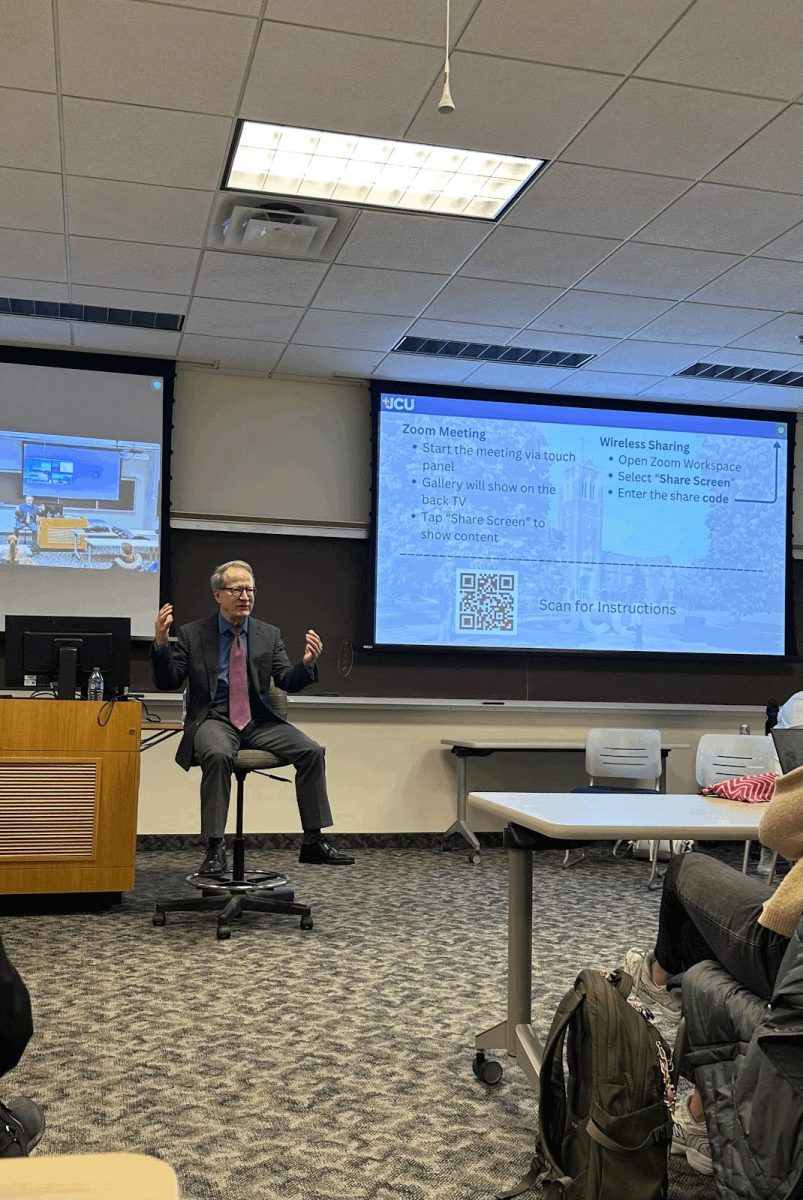
William Brownfield, former ambassador and current fellow at the Center for Strategic and International Studies (CSIS) explained the importance of paying attention to each country’s culture. Brownfield explained that understanding cultural subtleties including language, history, habits, tradition and ways of thinking is crucial for interpreting broader political dynamics.
Brownfield, in his presentation on March 12 at John Carroll University, emphasized the importance of building networks among diplomats, security agencies and local actors to develop links of trust in the long term.
He began his career in Venezuela in 1979 and subsequently held various diplomatic posts in Argentina, El Salvador, Panama and Geneva. In Washington, he served as an advisor and director in several offices focused on Western sphere affairs.
Brownfield went on to serve as U.S. Ambassador to Chile in the early 2000s, then to Venezuela from 2004-2007 and to Colombia from 2007 to 2010. These three countries are marked by significant political and security challenges, which in Brownfield’s view, enabled him to gain experience and a clear, unique perspective on the contemporary challenges facing not only him but the wider world. In particular, under the Hugo Chávez regime, he had to deal with significant tensions when Chávez declared in a speech, “if you keep on provoking us, start packing your bags, because I’ll kick you out of here,” accusing to him of provoking the Venezuelan population.
Between 2011 and 2017, he worked under Presidents Barack Obama and Donald Trump as Assistant Secretary of State for International Narcotics and Law Enforcement Affairs, leading U.S. efforts to combat drug trafficking and rising crime. Throughout his career, he has focused his efforts on international security cooperation, the fight against drug cartels and the strengthening of judicial institutions in partner countries, before retiring in 2017.
During the conference, Brownfield spoke to students about his diplomatic career in Latin America with enthusiasm. He shared memories of his postings and those of his wife, Kristie Kenney, in Chile, Venezuela and Colombia, as well as his missions to the United Nations. His remarks were rich with concrete anecdotes including his first day on the job when he watched his superior coldly fire five people in front of him. These anecdotes made for a vivid retelling of years of international conflict. Behind each story lay a profound reflection on local realities and difficult political decisions.
He also mentioned his time in Argentina and his consular work with Venezuelan teams, noting that this work, often described as “routine,” nevertheless reveals essential human aspects: migration, administrative procedures, and the hopes and struggles of citizens.
The conference then addressed the major geopolitical issues of today, presented in a clear and factual manner. Brownfield traced the political evolution of different Latin American regions. For example, Hugo Chávez (president of Venezuela) shifted from social populism toward authoritarian tendencies, Nayib Bukele (president of Salvador) remains highly popular despite coercive measures and Daniel Ortega (president of Nicaragua) refuses to relinquish power, thereby weakening the democratic processes he claims to uphold.