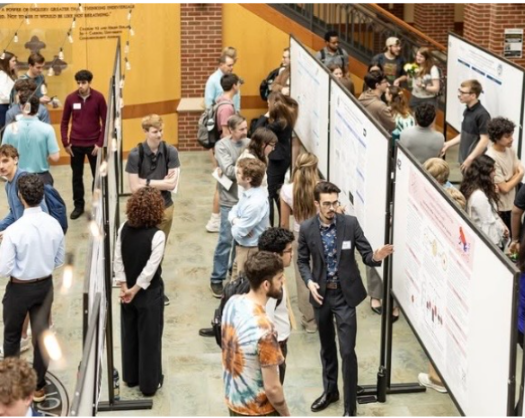
Aside from supporting students in performing well academically and encouraging them to find a sense of belonging on campus, John Carroll University strives to inform its community about the importance of taking care of oneself and prioritizing wellbeing. In addition to promoting the services offered at the counseling center, the university participates in campus-wide initiatives and movements to further emphasize the mental health of students, faculty and staff.
During the week of April 13, the Division of Student Experience & Campus Belonging hosted its first-ever Week of Wellness, where the entire JCU community was invited to participate in a variety of activities around campus following the theme of “Whole Person, Whole Life.” With the intent of advocating for wellbeing and mental health, each event was tied to one of the dimensions of wellness, which are physical & environmental, social & community, emotional & spiritual, academic & career, financial, as well as justice-oriented. Those who attended at least five events were given a free t-shirt and entered into a raffle for a JBL clip speaker, a special edition Owala water bottle and a JCU sweatshirt.
The idea for the campus initiative first came up in June 2025 for the purpose of thinking about the next steps to enhance campus wellbeing. Focus groups were held during the fall semester so students could give input about wellness at JCU. Matt Clark, director of recreation, led the coordination of the Week of Wellness, while Katharine Hahn Oh, director of the counseling center and executive director of student wellness & wellbeing, was in charge of the Okanagan Charter signing. Clark and Hahn Oh wanted something leading up to the charter adoption, so they felt the Week of Wellness was the best option.
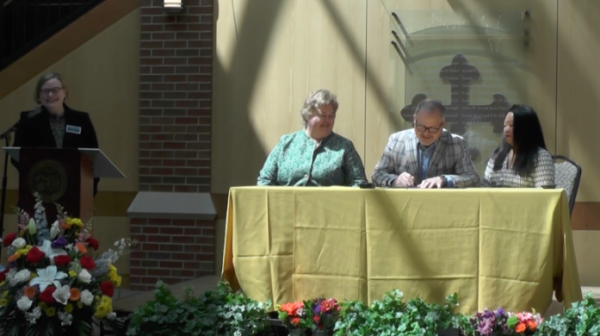
On April 17, the Okanagan Charter was signed, which is a statement of JCU’s commitment to wellbeing on campus and the community it’s part of. The university joined 45 other college campuses in the country that have already adopted the document. President Al Miciak, Vice President for Academic Affairs Bonnie Gunzenhauser and Vice President for Student Experience and Campus Belonging Naomi Sigg signed the charter.
Three projects were also recognized at the signing, which included the exercise science program collaborating with local first responders for fitness assessments, CSSA partnering with a juvenile detention center to bring JCU students and local teens together and a student-led computer science development of Nourish Net, which is an app that helps people find nearby food pantries.
Clark, who was in charge of putting together the logistics for the Week of Wellness, met with several departments and groups such as Campus Ministry, the Wellness Center and Student Government to assemble the schedule. Rather than creating all new gatherings, events taking place throughout campus during the week of April 13 were categorized into one of the wellness dimensions and compiled into one big itinerary. Hahn Oh stated that the purpose was for the JCU community to “enhance wellness individually [and] sense of community, being with others, [meeting new people] and working toward the same goal.”
The “Whole Person, Whole Life” theme came from the idea of caring for each other as whole people and enhancing wellbeing for the whole person. Hahn Oh believes this theme will reflect the goals of the Week of Wellness by “[helping] people tap into their authentic self and check in on and nourish themselves as a whole person.”
Jo Schierloh ’24 & ’28G, Wellness Center graduate assistant, was also involved in the planning process for the Week of Wellness by assisting Clark and Hahn Oh with advertising the initiative. She enjoyed “connecting with students” during her time working on this project and learned about “how [many] students advocate for and enjoy this idea or concept of wellness.”
“We could do this every year,” said Hahn Oh. “We also plan to meet as a campus-wide committee over the summer to plan one to two areas to focus on next year. One idea is focusing on rest and recovery since students tend to be driven to be involved in a lot of activities to the point where there’s no time for rest.”
Schierloh hopes the Week of Wellness inspires students to “prioritize their wellbeing, especially with finals coming up” and “[take] a minute to self-care” when they feel stressed. She also hopes that graduate students will attend more JCU events since “it’s important to highlight that these events aren’t just for undergrad students.”
“I hope that people will feel supported to take care of themselves and each other,” said Hahn Oh. “Not just focus on their performance or outcomes, but to value themselves regardless of how they’re doing.”
Hahn Oh continued, “Our long-term vision for this initiative over the next few years is every [student, staff and faculty member] has a set of habits and skills for holistic wellbeing by the time they graduate and are ready to adapt those habits and skills over the course of their life to maintain wellbeing.”
“We’re not just here to get good grades,” said Lysette Roman, social work graduate student at Case Western Reserve University and the graduate coordinator of the Wellness Center. “This is a place of becoming. We grow in relation to one another [and] don’t grow in isolation. Wellbeing is about being in proximity to other people and it’s not just grades that build you.”
“The biggest thing we hope is that [students got] some time for their own wellness or wellbeing,” Clark said. “I also hope they took away that John Carroll cares about this. This is just the start of our focus on wellness and wellbeing on this campus.”