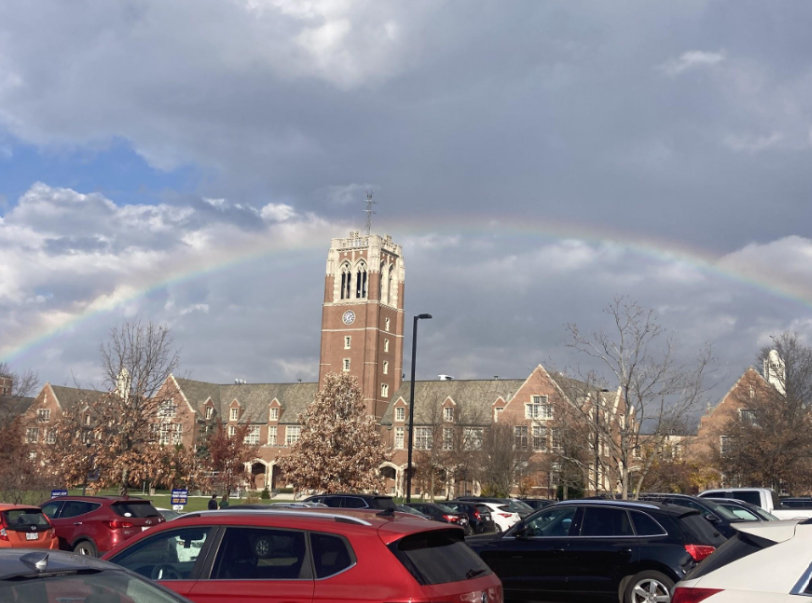
As students at John Carroll University transition into young adulthood and become independent, stressors may arise that prompt them to seek assistance from one of many campus resources. Whether it’s a first-year student getting used to living away from home or a graduating senior uncertain about tackling college debt, the university encourages students to take advantage of these services as much as possible.
One such resource is the university counseling center, which always accepts new clients and offers both in-person and virtual sessions. Services are free for all currently enrolled JCU students and information remains confidential unless there is an imminent safety threat.
According to Katharine Hahn Oh, counseling center director, the most common reason students seek counseling services is anxiety. Other reasons may include dating issues, breakups, difficult friendships, depression, being excluded by friend groups, navigation tips for academics and support for a collapsing social network.
Hahn Oh believes several factors are currently contributing to students’ overall mental health. Some examples are students “lacking the financial resources that they need, not [having] enough money for groceries, not knowing how to pay tuition next semester and having to work more than they should while in school.” In addition, some consider counseling due to “not finding their people on campus to spend time with,” as well as the “state of the world,” referring to the economy, politics and global conflicts.
The counseling center offers many ways to support their clients, such as individual counseling, group therapy, psychiatry, crisis services, consultations and workshops.
“We’re all trained and licensed therapists here and we have different approaches to therapy,” said Hahn Oh. “I think we mostly use a combination of listening and caring about our clients.”
Depending on clients’ presenting concerns, the counseling center might coordinate with other campus resources to support students’ mental health. For example, one may be referred to the Wellness Center, where one of the main services offered is wellness coaching. It is an easy, nonjudgmental way to connect with a staff member or peer advisor to discuss ways to achieve personal health goals. Any student interested in setting up an appointment can email [email protected]. To become a wellness coach, applications for a peer advising position can be submitted to the Wellness Center.
Another instance is connecting students to Emily Sherwood, associate dean of students and Title IX coordinator, to discuss complex family situations, for example. Title IX, a civil rights law that comes from the Education Amendments of 1972, states that “No person in the United States shall, on the basis of sex, be excluded from participation in, be denied the benefits of, or be subjected to discrimination under any education program or activity receiving federal financial assistance.” All schools that offer financial assistance to students are required to take steps to promote a safe and nondiscriminatory environment. In the event discrimination based on sex occurs at JCU, the university will quickly act to end and prevent it from happening again.
Clients whose mental health is affecting their daily functioning can be referred to Student Accessibility Services to receive academic accommodations. People that are facing financial hardship are sent to Student Enrollment and Financial Services. University counselors also encourage clients to get involved in student organizations and campus ministry to enhance their mental health.
Hahn Oh and Wellness Center Graduate Assistant Jo Schierloh ’24 & ’28G all believe that there are plenty of ways to actively engage in improving mental health and wellbeing.
“I would encourage students to choose one [dimension of wellness] to focus on, create a baby step or start a habit to enhance that aspect of wellbeing,” said Hahn Oh. “Pick one that would make the biggest difference in their wellbeing right now.” Schierloh added, “If you’re struggling with a class, go to the bathroom and walk around. Get off campus if you can [and] take the RTA.”
As JCU students continue to discover themselves and navigate independence, prioritizing mental health alongside academics is important. Through the various resources offered on campus, the university emphasizes that one shouldn’t be shy about seeking help. Addressing challenges early on, rather than letting them build up, allows for a more relaxed college experience as well as academic success.