

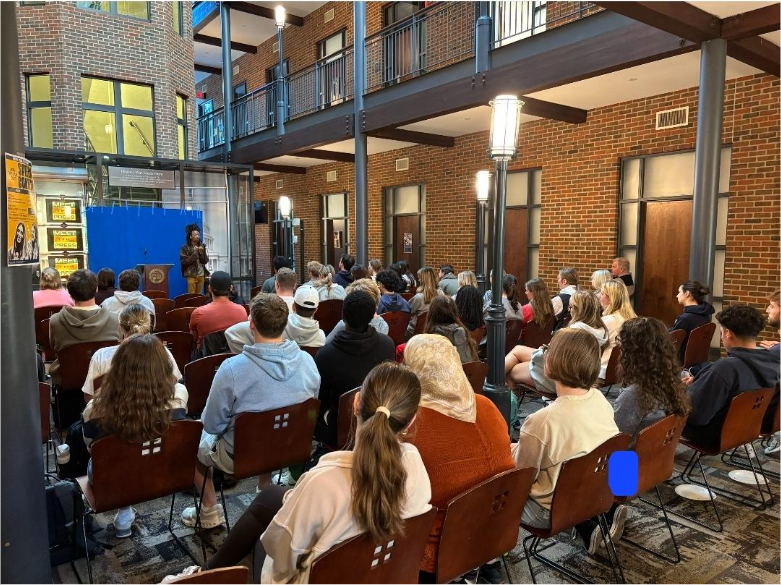
The O’Malley Center atrium echoed with spoken word and poetry as Damien McClendon shared his writing with students and faculty. Audience members sat still and held their breath while intensely listening to the powerful lines of Damien McClendon. To prepare for his first spoken word poem, McClendon paused and took two steps away from the microphone. His voice encompassed the entire atrium once he began.
McClendon, a Cleveland-based poet and writer, holds a dual licensure of a Master of Fine Arts (MFA) in creative writing and literary translations from Columbia University. His work has been published in Indiana Review, POETRY Magazine, Teachers and Writers Magazine and more. As a spoken word poet, McClendon was a finalist in the 2017 Individual World Poetry Slam and ranked in the top 10 at the 2018 National Poetry Slam as a member of Cleveland’s National Poetry Slam team.
McClendon’s exposure to poetry began when his mother, a nurse, would turn medical terminology into poems and songs to help her remember. As a child, McClendon said that, “when I thought of poetry, I thought of her.” He added that he never saw himself as a poet when he was a kid and was much more interested in dinosaurs and biology, although he would freestyle around the lunch table with his friends. Hip hop is how he fell in love with language. Poets and writers like Maya Angelou, Nikki Giovanni, Langston Hughes, Toni Morrison and Gwendolyn Brooks, who McClendon now says are some of his biggest influences, were ones he never got into until later in life.
Isaiah Hunt, a professor of English at John Carroll University, began the night on Oct. 15 by introducing McClendon to the attendees, sharing how he met McClendon at Kent State University and reminiscing about the passion and intensity McClendon had while sharing his spoken word at open mic nights and poetry slam events. Hunt wrote in his introduction that McClendon’s poetry reminds him of a conversation about “despite how the world continues to perceive Black men as threats, anomalies, obstacles, machines, statistical numbers, the mortality rate has sunk and the Black man still lives.”
Hunt encouraged the audience to read McClendon’s writing to know why Black men continue to survive, sharing, “it is Love. It is Black matriarchs. It is hand-me-downs that transcend monetary value and become relics to a family. But it is also action,” adding that in McClendon’s writing, “you will find a space where Black Men can exist in multitudes, not boxed in by the stereotypes and cliches of what a Black man can or cannot do.”
McClendon began the night reciting from memory two spoken word poems, as Marcus Lewis ’27 shared, “without a stutter.” McClendon explained that there are several rounds at slam poetry competitions, the first round being a minute-long poem recited from memory and the second round being a two-minute-long poem recited from memory. The two-minute-long spoken word poem he shared with the audience is titled “Word,” a poem that unravels one of the first times McClendon taught his now 10-year-old son slang. McClendon said that, “sometimes I can’t even recite it without tearing up.”
When asked what one thing McClendon would like the audience to take away, he paused for a moment before saying, “Challenging dominant narratives, being able to tell my own story in a way that fits me and my life and not having narratives of Black men or Black people imposed onto me.” He argued, “We shape our own stories.” The second half of McClendon’s spoken word event consisted of him reading poems that revolved around his childhood and upbringing in Youngstown, shaping his own story in the way he chose to.
After McClendon finished his poetry readings, Dewey Black ’27 recited his spoken word poem “What If?” With that, Kae’La Merritt ’27 stated that Black’s poem was one of her favorite moments of the night.
In addition to McClendon’s poetry reading, he also gave workshops in Hunt’s creative writing and fiction classes. Students were asked questions like “What is a human?” and “What is a machine?” and argued whether a human is a machine and vice versa. Elizabeth Bailey ’29 articulated that one of the main takeaways from her workshop with McClendon was asking herself, “What do we need to be more grateful for and mindful of and cautious of?” while questioning, “How can we be productive again?” She added afterwards that she’d love to see more open mic nights and would be thrilled if a poetry club could be created for students on campus.
When asked why he brings Cleveland writers to campus, Hunt explained that Cleveland, while smaller than cities like New York, Chicago and LA, has a lot to offer and added, “I love the newness it brings.” He explained that he wants his students to be given a framework for creative writing and to write in the way that suits them best, arguing this is why students need to hear from people other than himself. Hunt was very passionate about exposing students to local writers and poets, emphasizing “Cleveland has something to say.”
The night concluded with smiles and meaningful conversation about art and poetry. Merritt shared that what she loves about poetry is how “poetry tells a story in a condensed way,” and Lewis added that “poetry unravels the story as it’s told.”
Students can be on the lookout for the following upcoming English Department events:
- Oct. 28: A Dead Poets Society screening
- Nov. 10: Reception with Coach Kyle (English Distinguished Alumni Award)
- Nov 11: Zoom meeting with Margaret Renkl, a New York Times opinion writer, bestselling author, and former English Language Arts teacher of Reese Witherspoon
- Nov 14: Hopkins Festival of the Arts: “Six: The Musical” for students who sign up via this Google Form by October 24 at 5:00 pm
For more information, students can:
- Stay up-to-date with Inside JCU
- Check out the flyers in the O’Malley Center
- Email Hunt @ [email protected] to see what’s going on
- Follow the English Department’s Instagram @ englishjcu
Email the English Department @ [email protected] with any questions