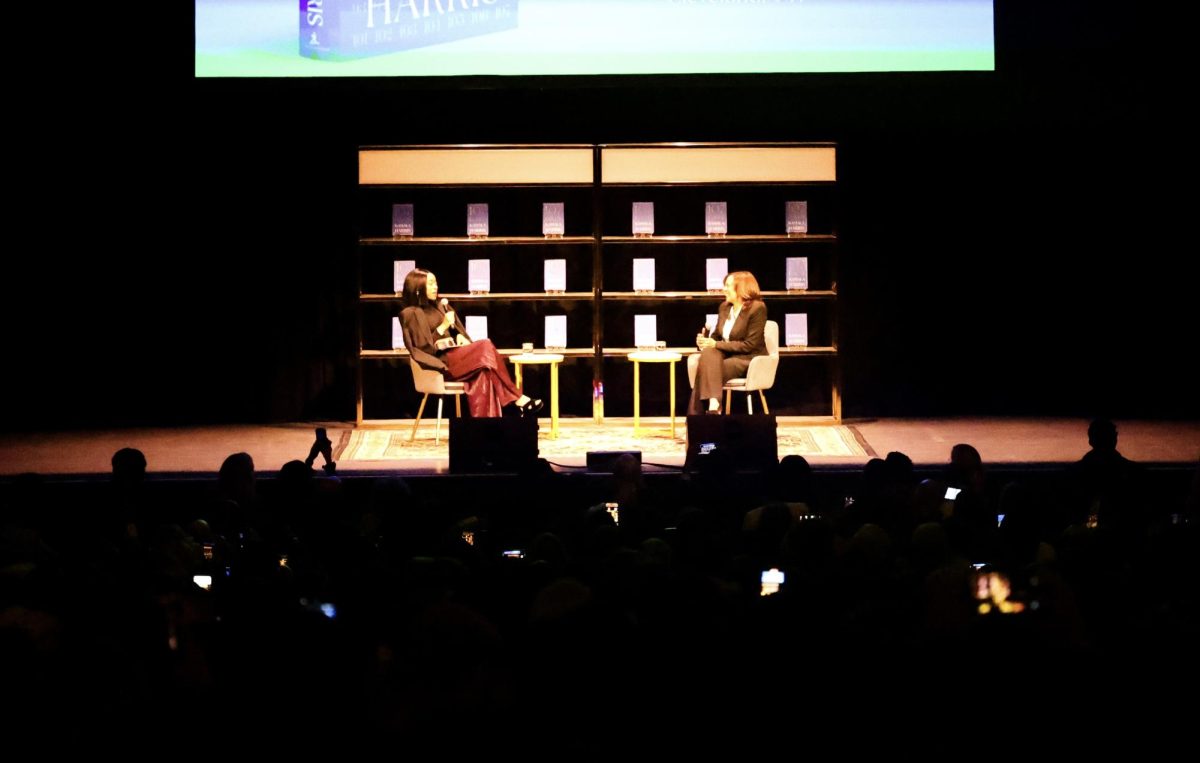
The energy inside the KeyBank State Theatre was joyful as former Vice President Kamala Harris stepped onto the stage Feb. 25, visiting Cleveland one day after President Trump’s State of the Union address and a year after her ill-fated rush to try to win the presidency, the subject of her new book, “107 Days.”
The appearance drew students, journalists, community members and political figures from across the state, including Cleveland Mayor Justin Bibb, former Secretary of Housing and Urban Development Marcia Fudge, Representative Shontel Brown of Ohio’s 11th Congressional District and Representative Emilia Sykes from Congressional District 13 of Ohio.
The event was also moderated by Cleveland-native and comedian Phoebe Robinson, who wasted no time seeking Harris’ view on the recent State of the Union address. In turn, Harris wasted no time responding. “Look, the man lies,” Harris said. “I am fascinated when he talks about a ‘roaring’ economy… What are we, in the 1920s?” Harris frequently had to bite her lip when referencing Trump, a habit that at one point prompted Robinson to exclaim, “Drag him!”
Still, while Harris kept the event light, it was clear that her loss to Trump had affected her. “Writing the book was the first I reflected, in any real way,” Harris said, calling election night “traumatic” and revealing she had not spoken to her husband, Doug Emhoff, about the event until she set out to write “107 Days.” Harris noted that she had observed a similar reaction in the broader political climate. Harris said, “People have often since the election asked me ‘what can we do?’”
In response, Harris called for a “project of civic renewal,” stressing the need for connection in an increasingly digital and fragmented world. In 2023, the Biden-Harris Administration’s surgeon general had cemented this concern by declaring an “epidemic of loneliness.” According to this report, loneliness can be as detrimental to health as smoking 15 cigarettes a day. In 2025, a survey conducted by the John Carroll Counseling Center and reported by The Carroll News revealed that 44% of students felt lonely due to a “lack of companionship.”
Harris said that the current political climate can exacerbate this loneliness, claiming that people are increasingly suspicious of their neighbors. She said that people are asking new questions, including “can I trust that you are not a threat to my very existence?” Still, Harris stressed that neighbor-to-neighbor interactions remain critical to community well-being. She repeated a favorite adage, asking the audience to “In the face of a stranger, see a neighbor.”
Harris also spent a significant amount of time speaking to younger generations, from whom the former Democratic nominee had lost some support in 2024. Specifically, Harris advocated for lowering the voting age to 16, a proposal which drew both cheers and groans from the mostly middle-aged audience. Harris argued that in the digital age, teenagers often operate similarly to and with the same information as voters just a few years older than themselves. Harris also mentioned that many of that age are “mature and aware.”
Throughout the evening, Harris floated between dire warnings and a conversational, casual tone. She emphasized the importance of community, especially in Ohio, as the 2026 midterms approach. “Ohio, you’re gonna be so important,” Harris said. But the majority of her comments were more general, speaking not to specific policy goals or agendas but to a broader need for civic re-engagement. Harris said that all people, especially young ones, have a role to play in their communities. “I think we all have light in us,” Harris stated, “I do believe that.”