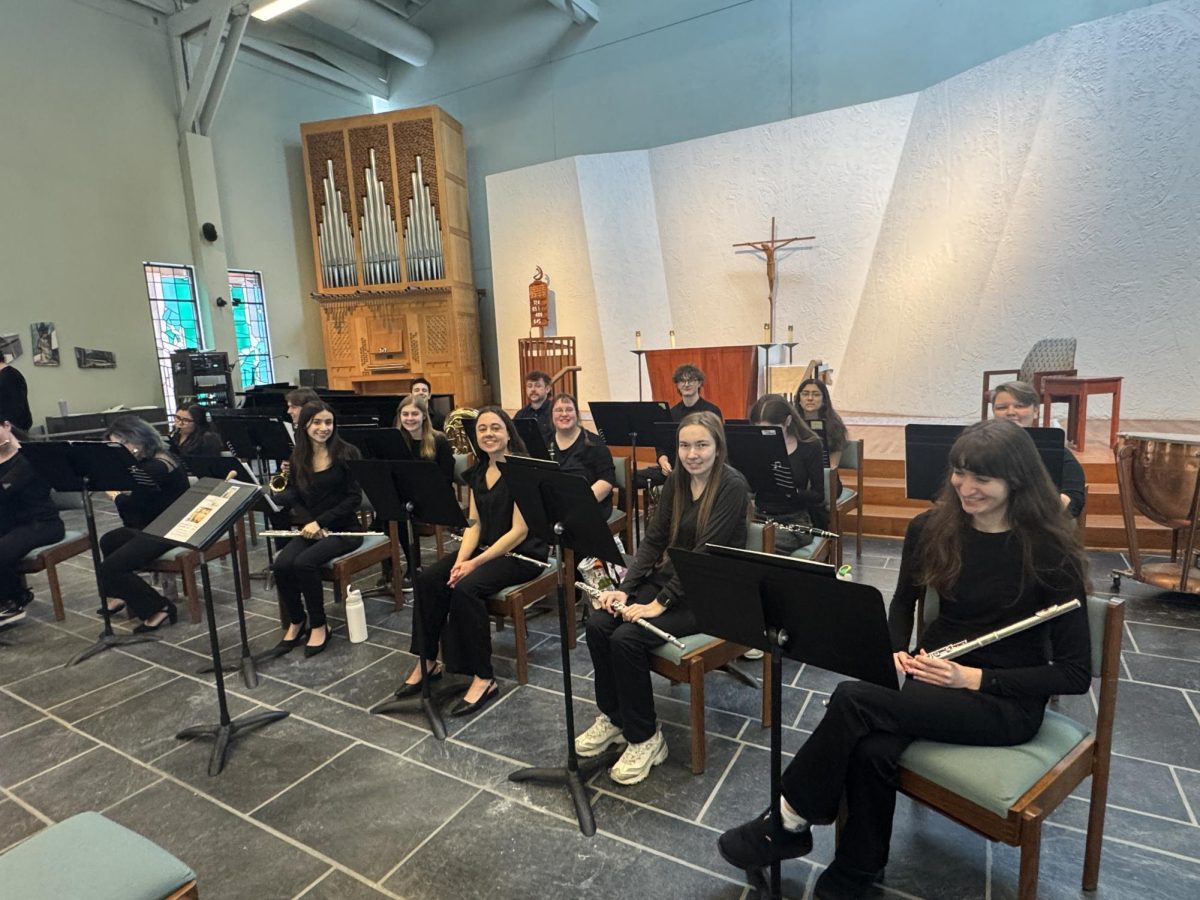
For two days, the St. Francis Chapel was filled with something rare: music no one had ever heard before. The American Mosaic concert, a central event in John Carroll University’s US@250 project, brought together the JCU Wind Ensemble and the Cleveland Composers Guild for a collaboration that turned academic work into a live performance experience on March 18-19.
The concert featured a series of world-premiere compositions by artists and Guild members, inspired by themes explored throughout the US@250 initiative. For students involved in research, interviews and creative projects, the performance marked the moment when their work moved from the page to the stage.
“This didn’t feel like a typical concert,” concertgoer Jackson Smith said. “It felt like a culmination of everything people have been working on all semester.”
The collaboration with the Cleveland Composers Guild also brought a professional dimension to the event. Composers worked closely with the ensemble to bring each new piece to life, many of which challenged both performers and listeners with complex rhythms, shifting tonalities and unconventional structures.
“You could tell the musicians were really engaged with the music,” University Heights resident Daniel Cox said. “There’s something different about playing a piece for the first time; it felt more immediate, more alive.”
Each composition approached the idea of the “American mosaic” from a different angle. Some pieces reflected moments of conflict and division, using dissonance and contrast to create tension. Others focused on unity and resilience, building toward more cohesive and lyrical sounds. Together, the works emphasized the diversity of experiences that shape the nation.
The two-night format also led to strong attendance across campus, with students, faculty and community members filling the space. The energy in the room built throughout each performance, particularly during moments when music and storytelling intersected.
The final piece of the evening brought all performers together in a culminating world premiere, weaving together musical themes from earlier in the program. As the last chord sounded, the audience paused briefly before responding with sustained applause.
For many on campus, the American Mosaic concert stood out not just for its musical quality but for its role in connecting different parts of the university community. By combining research, performance and collaboration, the event reflected the broader goals of the US@250 project.
“It showed what can happen when different disciplines come together,” Smith said. “It wasn’t just about music— it was about telling a bigger story.”
As JCU continues its US@250 programming, the American Mosaic concert will likely be remembered as one of its most ambitious and engaging campus events, one in which new music, new ideas and new perspectives took center stage.